
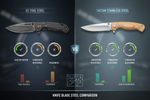
D2 vs 14C28N – Which Steel Is Better?
, by Outback Edge, 10 min reading time
, by Outback Edge, 10 min reading time
D2 offers better edge retention; 14C28N has superior toughness and corrosion resistance. Compare both steels using data from Knife Engineering to find your match.
D2 and 14C28N are two of the most commonly encountered knife steels at the mid-range price point, and they appear in a wide range of production knives from everyday carry folders to hunting blades and kitchen tools. The question of which is better does not have a single answer — the two steels are built around very different design priorities, and the right choice depends entirely on what you need the knife to do.
This guide compares D2 and 14C28N across the properties that matter in real use: edge retention, toughness, corrosion resistance, and ease of sharpening. All rating data is drawn from Knife Engineering by Dr. Larrin Thomas, a metallurgist whose research on knife steel properties is the most rigorous and independently tested available.
D2 is a high-carbon, high-chromium tool steel that has been used in knives for decades. Its typical composition is approximately 1.5% carbon and 12% chromium, along with molybdenum and vanadium. This combination produces a steel with large chromium carbides that give D2 high wear resistance and good edge retention.
D2 is classified as semi-stainless. Despite its 12% chromium content, Dr. Larrin Thomas explains in Knife Engineering that because of D2's high carbon content, a large proportion of the chromium is consumed forming carbides rather than remaining in solution to resist corrosion. As a result, only approximately half of that chromium is available to contribute to stain resistance. D2 will resist surface rust better than a plain carbon steel, but it is not immune to corrosion and will stain or pit with neglect — particularly in humid, coastal, or high-contact environments.
The large carbides in D2 also have implications for toughness. Knife Engineering includes micrographs of D2 showing the large white carbide particles distributed through the steel matrix, and notes that larger carbides reduce toughness compared to steels with finer carbide structures. This is a known trade-off: D2's wear resistance comes at the cost of brittleness under lateral stress and impact.
14C28N is a modified stainless steel produced by Sandvik, the Swedish steel manufacturer. It is a refined version of 13C26, with nitrogen added to the composition. The nitrogen serves two purposes: it increases the hardness ceiling and improves corrosion resistance by supplementing the chromium oxide passive layer.
With approximately 0.62% carbon and 14% chromium, 14C28N has a finer carbide structure than D2. The lower carbon content means less chromium is consumed forming carbides, leaving more chromium in solution to resist corrosion. The result is a genuinely stainless steel with excellent corrosion resistance — well above what D2 offers.
14C28N is widely used in production knives by brands such as Mora, Kershaw, and others. It is easy to sharpen, easy to grind and finish (because it lacks vanadium carbides), and cost-effective. Dr. Larrin Thomas specifically notes in Knife Engineering that 14C28N is among the easiest steels to polish or hand-sand to a fine finish.
Table 15.2 in Knife Engineering provides rated scores for knife steels across toughness, edge retention, and corrosion resistance on a ten-point scale, based on standardised testing. The data for D2 and 14C28N is as follows:
This is one of the largest gaps between the two steels, and it matters in practice. 14C28N is one of the tougher stainless steels available, comparable to AEB-L and significantly ahead of D2. D2's large carbide structure makes it susceptible to chipping or microchipping under lateral stress, impact, or tasks that would be well within the capability of a tougher steel. For a hunting knife used for field dressing, a folder carried in a work environment, or any application where the blade might be twisted or subjected to impact, 14C28N's toughness advantage is meaningful.
D2 holds an edge for longer. Its higher wear resistance, driven by the large chromium carbides, means it resists abrasive degradation more effectively than 14C28N. For tasks involving sustained cutting through abrasive materials — cardboard, wood, rope, sinew — D2 will hold a working edge for longer between sharpenings. However, this advantage narrows in practice: 14C28N is so easy to sharpen that restoring its edge is a quick process. A 14C28N knife can be brought back to sharp condition in a few passes on a fine stone or strop; D2 is more difficult to sharpen and requires more time and the right abrasive.
This is the clearest win for 14C28N. It is a genuinely stainless steel that performs well in humid, salty, or acidic conditions. D2, despite its surface-level similarity to stainless — it carries a high chromium content on paper — behaves more like a tool steel in practice. The experiment reported in Knife Engineering, comparing non-stainless, semi-stainless (D2), and stainless steels exposed to lemon juice, found that D2 showed intermediate sharpness loss from corrosive attack — significantly more than true stainless. For knives used in Australian coastal environments, humid outdoor conditions, marine applications, or food preparation, 14C28N's corrosion resistance is a practical advantage.
14C28N is significantly easier to sharpen than D2. The fine carbide structure responds well to standard sharpening stones, and the absence of vanadium carbides means it polishes readily. For most users, this is a practical daily-use benefit: a 14C28N knife is faster to touch up, easier to maintain on a strop, and more forgiving of imprecise sharpening technique.
D2 requires more effort and the right abrasive. Its large carbides resist fine stones and make sharpening on soft or worn stones frustrating. Diamond stones or quality synthetic stones work best for D2. The time required to restore D2 to a keen edge is noticeably longer than 14C28N, especially as the steel wears and the edge profile requires reprofiling.
Both steels can be heat-treated to similar hardness ranges. 14C28N reaches a maximum of around 62–63 HRC. D2, depending on heat treatment, typically falls in a similar range, though the performance of D2 at high hardness is constrained by its toughness — pushing D2 harder increases wear resistance but also increases brittleness. The higher hardness ceiling is more useful in 14C28N because the steel's toughness allows it to support a thinner, harder edge without chipping.
The correct answer to this question depends on the knife's purpose and the conditions it will be used in.
14C28N is the better choice when:
D2 is the better choice when:
It is worth noting that both D2 and 14C28N sit in the mid-performance tier of knife steels. As Dr. Larrin Thomas summarises in Knife Engineering, there are steels that improve on both — MagnaCut, for example, combines a toughness rating of 7.5 with a corrosion resistance of 9.5, effectively outperforming D2 in edge retention while offering far better toughness and corrosion resistance. AEB-L delivers similar toughness to 14C28N with better corrosion resistance.
The reason D2 and 14C28N remain common is primarily cost and availability. Both are well-understood steels, easy to source, and relatively inexpensive to process. At the price points where they appear, they represent reasonable value — provided the choice is matched to the application.
D2 and 14C28N are not competing for the same buyer. D2 offers better edge retention and wear resistance in dry conditions; 14C28N offers substantially better toughness, corrosion resistance, and ease of maintenance. For most everyday carry and outdoor use in Australian conditions — where humidity, salt air, and wet environments are common — 14C28N's combination of toughness and corrosion resistance makes it the more practical choice. For precision cutting tasks in controlled environments where abrasive edge retention is prioritised, D2 earns its place.
Browse our EDC Knives, Hunting Knives, and Kitchen Knives to find knives across both steel types. For more on knife steel properties, read our Best Knife Steel Explained guide.

THE SALE OF KNIVES AND OTHER CONTROLLED ITEMS TO MINORS IS PROHIBITED. 18 + only
Penalties apply.
Acceptable evidence of age may be required prior to finalising sale.
You are not old enough to visit the shop yet.