
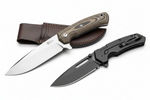
Fixed Blade vs Folding Knife: Which Is Better for Australian Conditions?
, by Outback Edge, 13 min reading time
, by Outback Edge, 13 min reading time
Fixed blade vs folding knife — a practical comparison for Australian conditions. Covers structural strength, safety, legality, and the best use case for each blade type.
The choice between a fixed blade and a folding knife comes up for most people buying their first serious knife, and it comes up again whenever someone finds that their current carry is not quite right for the job. There is no universal answer — both formats have clear strengths, and the better choice depends on what you are actually doing with the knife.
This guide covers the practical differences between fixed blade and folding knives: structural strength, safety, deployment, legal considerations for Australian users, and the conditions where each format performs best. Whether you are outfitting for hunting, choosing a kitchen workhorse, or picking an everyday carry option, understanding the trade-offs makes it easier to select the right tool.
A fixed blade knife has a single continuous piece of steel running from the tip to the end of the handle — the full tang. There are no moving parts, no pivot, and no locking mechanism required. The blade is structurally one unit with the handle, making it the stronger and more durable format by design.
A folding knife has a blade that pivots on a pin set into the handle. In the open position, a locking mechanism holds the blade in place. In the closed position, the blade tucks into the handle for safe carry. This compact format is convenient, but it introduces mechanical complexity and a potential point of failure that simply does not exist in a fixed blade.
For most practical tasks, a well-built folder performs reliably. But the structural difference becomes relevant under heavy load: prying, twisting, batoning wood, heavy field dressing, or any lateral stress applied to the blade. A fixed blade handles these tasks without compromise. A folder's locking mechanism is designed to resist cutting forces along the blade's axis, not the full range of stresses that a fixed blade absorbs through its rigid construction.
Fixed blade knives are the format of choice for hard outdoor use, hunting, bushcraft, survival tasks, and any situation where structural integrity under load is non-negotiable.
Folding knives dominate everyday carry precisely because they are compact, pocketable, and socially neutral. They are the practical choice for most urban environments and light-to-medium task scenarios.
The lock is the critical functional element of any folding knife. Understanding the main lock types helps in choosing a folder that suits the intended use.
Liner lock — a thin liner inside the handle flexes sideways to engage the blade tang when open. One of the most common lock types; reliable for everyday use but less robust under heavy lateral stress than a lockback or frame lock.
Frame lock — similar in principle to the liner lock, but the lock is formed by the handle frame itself rather than a separate liner. Stronger than a liner lock for the same reason: the locking piece is thicker and more rigid.
Lockback — a spine-mounted rocker that drops into a notch in the blade tang. Requires two-hand closing, which makes accidental closure less likely. A reliable and time-tested design — the Buck 110 Folding Hunter has used this mechanism since 1964.
Axis lock and similar — a spring-loaded bar that engages the blade from both sides. Smooth, ambidextrous, and generally considered one of the stronger lock types available in production folders. Requires regular cleaning to maintain reliable engagement.
Whatever lock type you choose, maintaining it matters. Grit, lint, or old lubricant in the lock face reduces engagement depth and can lead to blade play. Clean and lubricate pivots and lock faces regularly, especially after outdoor use.
Australia's environments — coastal humidity, tropical heat, dry outback dust, and salt air — affect both formats differently.
Fixed blades, because they have no pivot or lock mechanism, are easier to clean and dry thoroughly after exposure to salt water, blood, or humidity. A well-chosen steel and a proper sheath keep a fixed blade protected between uses.
Folding knives, with their pivots and internal mechanisms, accumulate moisture and debris more readily. In coastal or tropical environments, the inside of a folder's handle can trap salt moisture that corrodes the pivot pin, liner, or spring over time. This requires more attentive maintenance: periodic disassembly, cleaning, drying, and re-lubrication.
For hunters, anglers, and outdoor workers in humid conditions, a fixed blade made from a corrosion-resistant steel is often the more practical choice. For general everyday carry in an Australian city or suburban environment, a folder in a quality stainless steel serves well with basic maintenance.
Knife laws in Australia are state and territory specific, and they are worth understanding before choosing what you carry or how you carry it.
As a general principle across all states and territories: carrying a knife in a public place requires a lawful excuse. Hunting, fishing, work use, and other specific purposes are commonly listed as lawful excuses, but the specifics vary by jurisdiction. Blade length restrictions also apply in some states and affect both fixed blade and folding knives.
Fixed blades are generally legal to own, but carry in public is more restricted than folding knives in many states. A fixed blade in a sheath, visible on a belt, will attract more scrutiny in a public setting than a folder in a pocket.
Folding knives are generally treated more permissively for carry — but this does not mean there are no restrictions. Knives with assisted or automatic opening mechanisms, or those designed to be opened with one hand in ways that resemble prohibited items, may be subject to additional restrictions in some states.
For a full breakdown of the rules in each state and territory, read our Knife Laws in Australia guide. Always check current local legislation before purchasing or carrying any knife.
Fixed blade. The demands of field dressing — sustained cutting, exposure to blood and fat, potential for awkward angles and force — favour a rigid blade that can be cleaned thoroughly. A drop-point or clip-point fixed blade in a corrosion-resistant steel is the standard tool for this task. Browse our Hunting Knives and ESEE fixed blades for options suited to field use.
Fixed blade. Batoning wood, preparing food, processing camp materials, and general outdoor utility all benefit from the strength and simplicity of a fixed blade. A Scandi-ground or full flat-ground fixed blade in the 90–120mm blade length range covers most bushcraft tasks effectively. See our range of Bushcraft Knives for practical options.
Folding knife. The compact, pocketable format suits most everyday tasks — opening parcels, cutting rope, food prep, general utility. A quality folder with a reliable lock and a blade between 75–90mm covers most EDC use cases without the bulk of a sheath carry. Explore our EDC Knives range for suitable options.
Fixed blade (in kitchen knife form). Kitchen knives are fixed blades: they have the rigid structure, full blade length, and easy cleaning that daily food preparation demands. A folding knife in the kitchen is a compromise at best and a hygiene and safety concern at worst. Browse our Kitchen Knives to find the right blade for food prep.
Fixed blade with a corrosion-resistant steel. Salt water, fish blood, and constant moisture are hard on any mechanism. A fixed blade with minimal crevices, a proper sheath, and a steel like 14C28N or a similar stainless option will hold up better than a folder in these conditions.
Both formats require maintenance, but the nature of that maintenance differs.
A fixed blade needs edge maintenance (sharpening and stropping), cleaning after use, drying, and periodic oiling of the blade if the steel warrants it. The sheath should also be kept clean and dry. That is essentially the full maintenance list.
A folding knife needs all of the above for the blade, plus pivot maintenance: cleaning out lint, debris, and old lubricant from the pivot area; re-lubricating the pivot pin and lock face; periodically checking for blade play; and, for folders with detents, ensuring the ball bearing or detent is clean and engaging correctly. After heavy outdoor use — particularly in blood, salt water, or grit — a folder may need to be partially or fully disassembled for proper cleaning.
The practical starting point is to identify the primary use:
Blade length, steel choice, handle ergonomics, and sheath quality all matter once you have settled on the format. Getting the format right first makes the rest of the decision simpler.
Fixed blade and folding knives are different tools designed for different roles. Fixed blades offer structural integrity, easy maintenance, and suitability for hard outdoor tasks. Folding knives offer portability, discreet carry, and convenience for everyday use. Neither is universally better — the right choice is the one that matches the job.
Browse our full range of Hunting Knives, Bushcraft Knives, EDC Knives, and Kitchen Knives to find the format and blade that suits your needs. For more on knife maintenance, read our guide on Maintaining Knives in Australia.

THE SALE OF KNIVES AND OTHER CONTROLLED ITEMS TO MINORS IS PROHIBITED. 18 + only
Penalties apply.
Acceptable evidence of age may be required prior to finalising sale.
You are not old enough to visit the shop yet.