
Folding Knife Locks Explained: Types, Strengths and How to Choose
, by Outback Edge Imports, 7 min reading time
, by Outback Edge Imports, 7 min reading time
A practical guide to folding knife lock types — slip joint, lockback, liner lock, frame lock, button lock and modern crossbar locks — how each works and which suits your carry.
On a folding knife, the lock is the single most important safety feature. It is what holds the blade open and stable while you cut — and stops it folding back onto your fingers under load. Not all locks are equal: some are simple and time-proven, some are stronger, some are easier to use one-handed, and some are chosen because they keep your fingers clear of the blade path entirely.
This guide explains the main folding knife lock types you will come across, how each one works, what it is good at, and which suits hunting, trade work or everyday carry. Where it helps, we have pointed to knives in stock that use each system.
| Lock type | How it works | Best for |
|---|---|---|
| Slip joint | Spring tension holds the blade open — no positive lock | Light EDC, pocket tasks, simple carry |
| Lockback | Rocker bar drops into a notch in the blade tang | Hunting, camp, hard general use |
| Liner lock | A sprung liner leaf moves behind the blade | One-hand EDC and work folders |
| Frame lock | A section of the handle frame braces the blade | Heavy-duty EDC, strong lockup |
| Button / plunge lock | A spring-loaded button blocks the blade | Fast one-hand use, ambidextrous |
| Crossbar (Axis-style) | A spring-loaded bar rides over the tang | Ambidextrous use, fingers clear of the edge |
A folding knife has a pivot, which means the blade can move — and the lock is what stops it moving at the wrong moment. Under a hard push cut or when the blade binds in material, an unlocked or poorly locked blade can fold back toward your hand. A good lock holds the blade rigid so the knife behaves predictably and safely.
Lock choice comes down to three things: how strong the lock needs to be for your work, whether you need to open and close one-handed, and which side you operate it from. There is no single best lock — only the right lock for the job. One note for Australian buyers: automatic (spring-opening) and automatic out-the-front knives are prohibited imports, so every folder covered here is a manual-action design you open yourself.

A slip joint is not a lock at all. A backspring holds the blade open under tension, but the blade will fold closed if you push the edge hard against something. This is the mechanism in a classic Swiss Army knife such as the Victorinox Huntsman. The trade-off is obvious — less security under hard use — but slip joints are simple, light, have nothing to wear out or jam, and the non-locking action is often viewed as the most sensible format for low-key everyday carry. For light cutting, food, and general pocket tasks, a quality slip joint is all most people need.

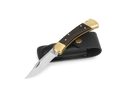
The lockback is one of the most proven locks in production. A rocker bar running along the spine drops into a notch cut in the blade tang when the knife opens, holding it solid; you release it by pressing the bar at the back of the handle. It is strong, ambidextrous, and resists the blade closing under heavy load, which is why it has been the standard on working folders for decades. The Buck 110 Folding Hunter and Buck 112 Ranger are the classic examples; the Buck 284 Bantam uses a compact mid-lockback. If you want a folder for hunting and camp work that simply will not let go, a lockback is hard to beat.

A liner lock uses a sprung leaf cut into one of the handle liners. When the blade opens, the leaf snaps across behind the tang to block it from closing; you push the liner aside with your thumb to release. The big advantage is genuine one-handed operation — open and close without your fingers ever crossing the blade path — which makes it a favourite for work and EDC folders. The OKC RAT II is a proven, affordable liner-lock folder, and the OKC XR-1 Extreme Rescue shows the same lock in a rescue-pattern blade.

A frame lock works on the same principle as a liner lock, but instead of a thin liner it uses a whole slab of the handle frame to brace the blade. That extra mass makes it one of the strongest and most reliable locks available, while staying easy to operate one-handed. The BRK Avispa pairs a moulded front with a steel frame lock, and the CMB Made Braveman uses an aerospace-grade titanium frame lock for a premium, rock-solid lockup. Frame locks suit anyone who wants serious strength in a slim, one-hand folder.

A button lock (also called a plunge lock) uses a spring-loaded button that drops into place to block the blade once it is open; press the button and the blade is free to close. It is fast, satisfying, and fully ambidextrous. The Kershaw Cybernet and Kershaw Kapsule are manual out-the-front designs that use a button-style lock with a slide deployment. Worth repeating for Australian buyers: these are manual-action knives — automatic versions are not legal to import — so you deploy and close them yourself.
The crossbar lock (you may know it by the Axis-style name) uses a spring-loaded bar that rides over the back of the blade tang and snaps into place when the knife opens. You retract the bar from either side, so it is fully ambidextrous and keeps your fingers completely clear of the edge during closing — one reason it has become so popular on modern EDC folders. The compression lock is another modern variant that uses a liner pinched between the blade tang and a stop pin for a very strong lockup, also closable without reaching into the blade path. Both are excellent choices if ambidextrous, fingers-clear operation is your priority. Browse the latest options in our Folding Knives and EDC Knives collections.
For hunting, camp and hard outdoor use: a lockback or frame lock. Both are strong, resist the blade closing under load, and the lockback in particular is simple to clean after messy field work.
For trade work and everyday carry: a liner lock or frame lock. Fast one-hand opening and closing keeps you working, and a quality frame lock adds strength for heavier tasks.
For low-key pocket carry and gifts: a slip joint Swiss Army knife. Light, simple, and the non-locking action is the most understated way to carry a blade for daily odd jobs.
For left-handers and anyone who wants fingers clear of the edge: a crossbar or button lock. Both are fully ambidextrous and close without your hand crossing the blade path.
A lock is only as good as its condition. Keep the pivot and lock faces clean — grit, dried blood, and pocket lint are the usual causes of a lock that feels notchy or sits inconsistently. A drop of light oil on the pivot keeps the action smooth. Before any hard cut, check the blade is fully open and the lock has engaged with a positive click. And always close the knife deliberately, keeping your fingers out of the blade’s path — most folding-knife injuries happen during careless closing, not cutting.
We stock folders across every lock type — from classic Buck lockbacks to liner-lock work knives and premium titanium frame locks — all dispatched from Yandina, QLD. Browse our Folding Knives and EDC Knives collections. To match the blade to the job, read our Knife Blade Shapes guide and Knife Steel guide, and check the Knife Laws in Australia guide before carrying any knife in public.

THE SALE OF KNIVES AND OTHER CONTROLLED ITEMS TO MINORS IS PROHIBITED. 18 + only
Penalties apply.
Acceptable evidence of age may be required prior to finalising sale.
You are not old enough to visit the shop yet.