
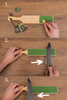
How to Use a Leather Strop Properly: Technique, Pressure, and When to Strop
, by Outback Edge, 8 min reading time
, by Outback Edge, 8 min reading time
How to use a leather strop correctly — angle, pressure, and motion for a properly finished knife edge. Covers compound use and common mistakes to avoid.
A leather strop is one of the simplest and most effective tools for refining a knife edge after sharpening. Used properly, it removes the burr, polishes the apex, and improves cutting performance without removing significant steel.
At Outback Edge Imports, we treat stropping as a practical part of every sharpening routine — not an optional extra. For the full sharpening process that precedes stropping, read our Complete Guide to Knife Sharpening.

A leather strop used incorrectly can round the apex, fold the burr rather than remove it, or damage the leather surface. Used correctly, it is the step that takes a sharpened knife from functional to genuinely refined.
Dr. Larrin Thomas explains in Knife Engineering that sharpness is controlled by the width and radius of the very tip of the edge apex. Stropping directly targets that apex — cleaning it up and reducing the burr left by the sharpening stone. The difference between a properly stropped edge and an unstopped one is often immediately noticeable in cutting performance.
For a deeper look at how stropping fits into the full process, read our Complete Guide to Knife Stropping.
A leather strop is used after sharpening to refine the edge at a microscopic level. It does not replace a sharpening stone — it completes the job the stone started.
Stropping helps:
This technique applies equally to kitchen knives and outdoor fixed blades. Hunting knives Australia — particularly the fixed blades in our Buck knives range and ESEE knives range — benefit especially from regular stropping, as a refined working edge matters in the field where a sharpening stone may not be available.
Not sure which strop to choose? Read our guide on kangaroo leather vs cow leather strops.
This demonstration shows the basic motion, angle, and pressure needed to use a leather strop correctly — watch before working through the steps below.
Apply a light, even coating of stropping compound to the leather surface. You do not need to overload it — a thin, consistent layer is enough. Too much compound can build up and reduce effectiveness over time.
Place the knife on the strop at roughly the same angle used during sharpening — typically 15°–20° per side for most knives. Consistency with your sharpening angle matters more than hitting an exact number. Lifting the spine too high will miss the apex entirely.
Draw the knife away from the cutting edge — spine leading, edge trailing. This is the opposite direction to sharpening. Never push the edge into the strop; this cuts the leather and can roll or damage the apex. Travel the full length of the strop and the full length of the blade's edge in one smooth, continuous motion.

Alternate sides with each pass, using light and even strokes. Start with around 10–20 passes per side and adjust based on the knife and edge condition. As the edge refines, reduce pressure further with each pass.
Feel the edge with your thumb held perpendicular to the blade — never run your thumb along the edge lengthwise. A well-stropped edge will feel clean and catch smoothly. For a more demanding test, try slicing a piece of stiff leather scrap, which is a better sharpness indicator than paper.
If you want a second perspective, this video gives a broader educational overview of strops and their use — useful for understanding the different strop types and how each fits into a sharpening routine.
Use light pressure — the weight of the blade is often enough. Stropping is about refinement, not aggressive steel removal. Too much pressure can:
Think of it as polishing, not grinding. Reduce pressure progressively as you work through your passes.
Between sessions, a honing steel can also help maintain the edge alignment. For broader knife care, read our guides on maintaining knives in Australia and preventing knife rust in Australia.
Using a leather strop properly is a simple skill that makes a noticeable difference in knife performance. It works best as the final step in a complete sharpening routine — after sharpening stones have done the heavy work and, where appropriate, a honing steel has been used between sessions.
At Outback Edge Imports, we stock a practical range of stropping tools suited to home cooks, outdoorsmen, and professionals.
Explore our leather strops, stropping compounds, and sharpening stones to build a complete sharpening setup. See our full range of Kitchen Knives, Bushcraft Knives, EDC Knives, and Hunting Knives.

THE SALE OF KNIVES AND OTHER CONTROLLED ITEMS TO MINORS IS PROHIBITED. 18 + only
Penalties apply.
Acceptable evidence of age may be required prior to finalising sale.
You are not old enough to visit the shop yet.