
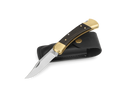
Buck Knives Australia: The Complete Range Guide
, by Outback Edge, 14 min reading time
, by Outback Edge, 14 min reading time
A complete guide to the Buck Knives range in Australia — the 110 and 112 Folding Hunter family, Bantam pocket folders, and the hunting fixed blade line. Covers 420HC steel, the Forever Warranty, and which model suits your use.
Buck Knives has been making folding and fixed blade knives in the United States since 1902. In Australia, the name is best known for one model — the 110 Folding Hunter — but the range runs a lot deeper than a single knife, covering compact pocket folders, full-size lockbacks, and a hunting fixed blade line that spans everything from a 45-gram caping knife to a full 6-inch clip blade.
This guide covers the complete Buck range we stock at Outback Edge, organised by the job you need the knife to do rather than by model number. If you already know you want a Folding Hunter and just need to settle 110 versus 112, we have a dedicated comparison of those two. If you are starting from scratch, start here.
Three things make Buck worth the shelf space in a range built around working tools.
420HC steel, heat treated properly. 420HC is not an exotic steel, and Buck does not pretend otherwise. It is a mid-range stainless with good corrosion resistance and moderate edge retention. What makes Buck's version worth having is the heat treatment — Buck runs it to around 58 HRC, which is at the high end of what 420HC will take. The result is a steel that holds a working edge respectably, resharpens quickly with basic equipment, and shrugs off humidity and blood without pitting. For Australian conditions — coastal humidity, wet field work, long gaps between cleanings — that combination is more useful day to day than a super-steel that takes an hour on a diamond plate to bring back.
The Forever Warranty. Buck warrants its knives for the life of the knife against defects in materials and workmanship. That is not a marketing line with an asterisk — it is the reason a lot of Buck knives get handed down rather than replaced.
Made in the USA. The fixed blades and the Folding Hunter family are US-made. The Bantam folders are made in the USA with imported parts, which Buck states plainly on the packaging.
If you want the longer version of how steel choice affects real-world performance, our guide to knife steel covers edge retention, toughness and corrosion resistance in more detail.
The 110 Folding Hunter launched in 1964 and is the knife that made the locking folder a serious tool rather than a novelty. Before it, hunters carried fixed blades because folders were not trusted to stay open under load. The 110's lockback changed that. The 112 Ranger followed in 1972 as the smaller sibling, and between them they account for most of what people mean when they say "a Buck knife".
Both share the same essentials: a 420HC clip point blade, a lockback mechanism, genuine ebony handle scales with bolsters on the traditional models, and a leather sheath. The difference is size — the 110 carries a 9.5 cm blade, the 112 a 7.6 cm blade.
110 Folding Hunter Classic (110BRS) — the original specification: ebony scales, brass bolsters, 9.5 cm clip point, genuine leather sheath, 204 g. This is the knife as three generations of hunters have known it.
110 Folding Hunter Finger Grooved (110BRSFG) — Buck owners were cutting finger grooves into their own handles for years before Buck made it an official option in 1982. The grooves index your hand and stop it sliding forward on wet or repetitive cuts. If you use the knife hard for field dressing, this is the more practical handle.
110 Folding Hunter LT (0110BKSLT-B) — same 9.5 cm blade, nylon handle instead of ebony and brass, and 91 g instead of 204 g. Less than half the weight for the same cutting capability. Comes with a polyester sheath rather than leather. This is the sensible choice for hikers, campers and anyone who found the classic too heavy for all-day carry.
112 Ranger Classic (112BRS) — ebony and brass, 7.6 cm blade, 142 g. Everything the 110 does, scaled down enough to pocket comfortably.
112 Ranger Nickel Silver (112BRS4-B) — the nickel silver bolster version of the Ranger.
112 Ranger Finger Grooved (112BRSFG) — the grooved handle on the compact platform, for the same reason as the 110 version.
112 Slim Select (112BKS1) — the modern interpretation: slim black polymer handle, no bolsters, 105 mm closed. Same blade and lock as the Ranger in a flatter, lighter package that disappears in a pocket. The easiest 112 to carry every day.
The lockback used across this whole family is one of the oldest and most reliable locking designs in production. If you want to understand how it compares to liner locks, frame locks and the newer crossbar designs, our guide to folding knife locks explains each type.
The Bantam line is Buck's answer to everyday carry: lightweight synthetic-handled lockbacks with thumb studs for one-hand opening, at a fraction of the weight of the Folding Hunter family. All four use 420HC drop point blades and a mid-lockback mechanism.
| Model | Blade | Weight | Carry |
|---|---|---|---|
| 284 Bantam BBW | 7.0 cm | 43 g | Pocket, lanyard hole |
| 285 Bantam BLW | 7.9 cm | 68 g | Removable steel pocket clip |
| 286 Bantam BHW | 9.5 cm | 91 g | Pocket clip + lanyard hole |
284 Bantam BBW — the smallest and lightest. At 43 g it genuinely disappears in a pocket, glovebox or tackle bag. Dual thumb studs, ridged spine for grip, lanyard hole. Also available in Mossy Oak Break-Up camo.
285 Bantam BLW — a step up in blade length with a wide sloping edge that suits camp chores and general utility, plus a removable stainless pocket clip. Glass-reinforced nylon handle in black. The most conventional EDC knife in the Bantam line.
286 Bantam BHW — the largest Bantam, with a 9.5 cm blade matching the 110 Folding Hunter but at 91 g rather than 204 g. If you want real blade length in a folder without the weight of a traditional handle, this is it. Orange Head Hunter camo handle, pocket clip and lanyard hole.
Worth noting for Australian buyers: blade length and carry context matter under state knife laws, and a shorter blade is generally easier to justify. Our guide to Australian knife laws covers the requirements state by state. None of these knives is sold or marketed as a self-defence tool — they are cutting tools for hunting, camping, trade and general utility work, and should be carried and used on that basis.
Buck's fixed blade line covers a wider spread than most people expect — from a skeletal caping knife to a full-size hunting classic. All are 420HC and all come with a sheath.
119 Special (119BKS) — the fixed blade counterpart to the 110's reputation. A 6-inch clip blade with a black phenolic handle, polished aluminium guard and butt, and a genuine leather sheath. The long belly gives you plenty of cutting length for skinning and breaking down larger animals, while the clip point keeps tip control for finer work. At 227 g it is a substantial knife and it carries on a belt rather than in a pack.
192 Vanguard (192BRS) — the most refined fixed blade in the hunting line. A 4.25-inch drop point, which is the more forgiving shape for game processing because the lowered tip is far less likely to nick a gut sack during a field dressing cut. Heritage Walnut DymaLux handle with polished brass guard and butt, leather sheath. This is the one to buy if you want a hunting knife that looks as good as it works.
105 Pathfinder (105CCS1) — effectively a compact 119. A 5-inch modified clip blade with full tang construction, integrated finger guard, thumb ridges and a deep choil for choking up on the blade. The DymaLux Cocobolo handle is a laminated wood composite that gives you the look and warmth of natural cocobolo with far better moisture and impact resistance — a sensible choice for a knife that gets wet.
664 Alpha Hunter Select (664ORS) — a modern hunting fixed blade with a hollow-ground 9.2 cm drop point for clean, efficient slicing, and jimping on the spine for thumb control across grip positions. The glass-filled nylon handle with Versaflex inlays is built for grip when your hands are wet, cold or gloved — which is most of the time when it matters. High-visibility orange handle and a polyester belt sheath.
635 PakLite Cape (635ORS) — 45 grams. A full-tang skeletal blade built for caping and trophy work, with a removable glass-filled nylon handle that improves grip in use and comes off for cleaning. Purpose-built for caping, but equally at home on small game and birds, and light enough that there is no argument for leaving it behind on a pack hunt.
102 Woodsman (102BKS) — a compact 4-inch fine point fixed blade at 74 g, with a black phenolic handle and leather sheath. The fine point makes it the pick for fish, small game and detailed camp work where control matters more than cutting length. The natural companion to a larger knife rather than a replacement for one.
If you want one knife for everyday carry: the 112 Slim Select or the 285 Bantam BLW. Both are light, pocket-clip friendly and legal-length sensible for general carry. The Slim Select gives you the traditional Buck lockback feel; the Bantam is lighter and opens one-handed.
If you hunt: a fixed blade and a folder. The 192 Vanguard or 664 Alpha Hunter Select for field dressing, backed by a 110 Finger Grooved for everything else. If you cape or take trophies, add the 635 PakLite Cape — it weighs nothing and does a job the others cannot.
If you camp, hike or work outdoors: the 110 LT is the value pick — full-size cutting ability at 91 g. Pair it with the 102 Woodsman if you want a fixed blade for food prep and fire work. Our camping knife guide covers how these compare to the rest of the range.
If you are buying a gift or something to keep: the 110 Folding Hunter Classic or the 105 Pathfinder in Cocobolo. Ebony and brass on one, DymaLux Cocobolo and full tang construction on the other, and a lifetime warranty behind both. These are knives that outlast the person who buys them.
420HC is forgiving, but it is stainless rather than stainproof. Wipe the blade down after use, particularly after contact with blood, salt water or acidic food. A light film of food-safe or mineral oil on the blade and a drop on the pivot keeps a folder running smoothly and prevents surface corrosion.
Sharpening is where 420HC earns its keep. It takes an edge quickly on a medium stone and responds very well to a strop finish — you can bring a dulled Buck back to shaving sharp in a few minutes without specialist equipment. Our complete sharpening guide covers angles and technique, and the sharpening range has the stones, steels and strops to do it.
Is 420HC good knife steel?
For a working knife, yes. 420HC is a mid-range stainless with good corrosion resistance and moderate edge retention. Buck heat treats it to around 58 HRC, which is at the top of its range and gives noticeably better edge holding than 420HC from most other makers. It will not hold an edge as long as a premium powder steel, but it resharpens far more easily — which for most users is the more useful trait.
What is the difference between the Buck 110 and 112?
Blade length, mainly. The 110 has a 9.5 cm blade and weighs 204 g; the 112 has a 7.6 cm blade and weighs 142 g. Both use the same steel, lock and handle materials. The 110 suits belt carry and larger game; the 112 pockets more comfortably and is the easier everyday carry.
Are Buck knives made in the USA?
The Folding Hunter family and the fixed blades are made in the USA. The Bantam folders are made in the USA with imported parts, which Buck states on the packaging.
What does Buck's Forever Warranty cover?
It covers defects in materials and workmanship for the life of the knife. It does not cover normal wear, misuse or loss.
Which Buck knife is best for hunting in Australia?
For field dressing, the 192 Vanguard or 664 Alpha Hunter Select — both use drop point blades, which are more forgiving on gut cuts than a clip point. For a folder, the 110 Finger Grooved gives you the most secure grip when your hands are wet. Our hunting knife guide compares these against the rest of the range.
Browse the full Buck Knives collection, or the wider folding knives, fixed blade knives, hunting knives and EDC ranges. Dispatched from Yandina, QLD.
Trade and volume enquiries welcome — call us on 0489 229 879.

THE SALE OF KNIVES AND OTHER CONTROLLED ITEMS TO MINORS IS PROHIBITED. 18 + only
Penalties apply.
Acceptable evidence of age may be required prior to finalising sale.
You are not old enough to visit the shop yet.