
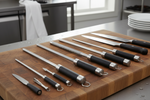
Knife Sharpening Steels Explained: Types, Uses, and How to Choose the Right One
, by Outback Edge, 14 min reading time
, by Outback Edge, 14 min reading time
Not all sharpening steels do the same job. This guide explains the difference between smooth, grooved, ceramic, and diamond rods — and how to choose the right one for your knives.
If you want your knives to stay performing at their best, understanding knife sharpening steels is essential. Many people buy a honing rod or sharpening steel without knowing that different types do very different jobs. Some are designed to realign an edge, while others actually remove steel and help restore sharpness.
In this guide, we explain the main types of knife sharpening steels, what they are used for, and how to choose the right one for your kitchen knives, butcher knives, outdoor knives, and work knives.
Whether you are a home cook, chef, butcher, hunter, or tradesman, knowing the difference between smooth steels, grooved steels, ceramic rods, and diamond rods will help you maintain your knives properly and extend the life of the edge.
For a deeper understanding of how blade steel affects sharpening, see our complete guide to knife steel types.
A knife sharpening steel, often called a honing steel or honing rod, is a long rod used to maintain a knife edge between full sharpening sessions.
Despite the name, not every sharpening steel actually sharpens a knife in the traditional sense. In many cases, a steel is used to realign the very fine edge of the blade after it has rolled slightly during use. Other rods, such as ceramic and diamond-coated options, are more abrasive and can remove metal from the blade, making them more like light sharpening tools.
For most knife owners, the important thing to understand is this:
That makes rod selection important, especially if you own a mix of kitchen knives, butcher knives, EDC knives, outdoor knives, or harder Japanese-style blades.
Before choosing a sharpening steel, it helps to understand the difference between honing and sharpening.
Honing helps keep an edge performing well by realigning the microscopic edge of the knife. It does not usually remove much steel. Honing is best used when a knife is starting to feel less precise but is not truly dull.
Sharpening removes material from the blade to create a fresh apex. This is what you do when the knife has become properly dull and no longer cuts efficiently.
A lot of people expect a honing rod to bring a completely blunt knife back to life. In reality, if the edge is worn out, chipped, or badly rounded over, you will usually need a whetstone, sharpening system, or abrasive rod rather than a standard steel. Read our knife maintenance guide for a broader look at keeping your blades in top condition.
There are several main types of sharpening steels, and each has its own purpose.
A smooth steel has a polished surface with little or no visible texture. This type is primarily used for realigning the edge rather than grinding material away.
A smooth steel is often a good option for people who use softer European-style kitchen knives and want a maintenance tool that is less aggressive.
A grooved steel has ridges or teeth running along the rod. This style is more aggressive than a smooth steel and is commonly seen in butcher shops, commercial kitchens, and trade environments.
Grooved steels are popular because they work fast, but they are not the best choice for every knife. On thin, hard, or fine-edged blades, they can be overly aggressive.
A fine-cut steel sits between a smooth rod and a coarse grooved rod. It has a lightly textured surface designed to provide controlled edge maintenance with less aggression than a traditional butcher's steel.
For many users, a fine-cut steel is a practical all-round option for softer kitchen knives that see regular use.
A ceramic honing rod is one of the most versatile edge maintenance tools available. Ceramic rods are harder and more abrasive than standard steel rods, so they can both refine an edge and remove a small amount of metal.
That means a ceramic rod is often better described as a light sharpening tool as well as a maintenance tool.
For many modern knife users, ceramic is one of the best all-round choices. It is especially useful for people who own harder stainless steels, carbon steels, or Japanese knives that do not respond as well to traditional steels. Understanding your blade steel helps here — see our knife steel guide for more detail.
A diamond sharpening steel or diamond-coated rod is the most aggressive type commonly sold in rod form. It uses industrial diamond abrasives bonded to the surface, allowing it to cut steel quickly.
Diamond rods are best treated as a light sharpening tool rather than a standard daily honing rod. They are excellent when used correctly, but for everyday maintenance they are usually more aggressive than necessary.
The best sharpening steel depends on the type of knives you own and how you use them.
For softer Western kitchen knives, a smooth steel, fine-cut steel, or ceramic rod is usually the best choice. These knives often benefit from regular maintenance and respond well to honing. Browse our range of kitchen knives.
For Japanese kitchen knives and other harder, thinner-edged blades, a ceramic rod is usually the better option. Coarse grooved steels can be too aggressive and may damage or micro-chip delicate edges.
For butcher knives and heavy-use work knives, a grooved steel or fine-cut steel is often practical. These tools are designed for fast edge maintenance where a working edge matters more than a highly polished finish.
For outdoor, field, or hunting use, a diamond-coated rod or compact ceramic rod can be very useful. These tools offer quick maintenance in a portable format and are well suited to work knives that may need fast touch-ups. See our hunting knives, bushcraft knives, and camping knives.
When buying a knife sharpening steel, consider these factors.
Softer knives tend to respond well to traditional steels. Harder knives usually do better with ceramic or very controlled abrasive sharpening. Our knife steel guide explains hardness and steel types in detail.
Thin, fine edges need gentler maintenance. Thick working edges can often handle more aggressive rods.
If the knife only needs a quick touch-up, a honing rod may be enough. If it is properly dull, a ceramic rod, diamond rod, or full sharpening system will be a better choice.
Chefs, butchers, and tradespeople may need regular maintenance. Casual home users may only need occasional honing and periodic sharpening.
A smooth or ceramic rod generally gives a cleaner edge than a coarse grooved or diamond rod.
Even the best sharpening steel will not help much if it is used incorrectly. Good technique matters.
A common mistake is using too much force. A sharpening steel is not meant to be used like a file. Gentle, controlled strokes are far more effective and far safer.
There is no single rule, because it depends on how often the knife is used and what it is cutting.
As a general guide:
If a few passes on the rod do not improve performance, the knife probably needs proper sharpening rather than more honing. See our full knife maintenance guide for more tips.
Many people damage edges or get poor results simply by using the wrong rod for the job.
Hard, thin-edged knives can be damaged by aggressive grooved rods.
If the knife is truly dull, honing alone usually will not solve the problem.
Heavy pressure can damage the edge and reduce control.
Ceramic and diamond rods can clog with metal particles and need cleaning to perform properly.
Not all knives should be maintained the same way. A butcher knife, chef knife, and Japanese gyuto may all need different tools. If you are unsure which knife type you own, see our guide on fixed blade vs folding knives.
Proper sharpening is only part of knife care. In Australia's humid and coastal conditions, rust can be a real issue — especially with carbon steel blades. Read our guide on how to prevent knife rust in Australia to keep your blades in top shape.
Understanding the different types of knife sharpening steels makes it much easier to care for your knives properly.
Here is the simple breakdown:
For many people, the best setup is a ceramic rod for regular touch-ups and a whetstone or sharpening system for full sharpening when needed.
If you want to keep your knives cutting cleanly, safely, and efficiently, choosing the right sharpening steel is one of the easiest upgrades you can make. Browse our full range of kitchen knives and professional knives to find the right blade for your needs.
For a complete breakdown of sharpening technique, grit selection, and how to choose the right system for your knives, read our Complete Guide to Knife Sharpening.
A honing steel usually realigns the edge, while a sharpening steel may also remove material depending on the surface. Ceramic and diamond rods are more abrasive and act more like sharpening tools.
Ceramic rods are often more versatile because they can lightly sharpen as well as refine the edge. They are especially useful for harder knife steels.
A traditional steel rod usually will not restore a truly dull knife. A ceramic or diamond rod may help, but badly worn edges usually need full sharpening.
Diamond rods are very effective, but they remove steel quickly. They are excellent for fast sharpening and touch-ups, but they should be used carefully.
For most kitchen knives, a smooth steel, fine-cut steel, or ceramic rod is a good choice. Ceramic is often the most versatile option.
Japanese knives usually benefit from a ceramic rod rather than a coarse grooved steel, especially if the blade has a hard, thin edge.
Disclaimer: This article is for general information only. Always ensure any knife you purchase, carry, or use complies with the laws in your state or territory. See our guide on knife laws in Australia.

THE SALE OF KNIVES AND OTHER CONTROLLED ITEMS TO MINORS IS PROHIBITED. 18 + only
Penalties apply.
Acceptable evidence of age may be required prior to finalising sale.
You are not old enough to visit the shop yet.